Showing posts with label Jewelry Body Piercing. Show all posts

Nose Rings (literally the Ring) are Becoming Mainstream

You have seen an occasional full size ring being worn in a nostril piercing, but it use to be a small percentage of people that would wear the 360 degree ring.

We find that our customer base is starting to ask for a full ring much more frequently. Also, when walking among the public, there are more sightings of this nose jewelry.

In the way back machine (a year or so, lol) there was only the standard captive bead ring, but now there are better options.

The continuous ring is very desirable in the 14 karat white or yellow gold. You just push the gold to one side, put it on, and push it back into position.

Continuous rings also do come in steel. There is a small section of the ring that is removable and a bit tricky to put back into place. It's worth the effort to have a ring that looks like there is no ending point.

Industrial Piercing

Industrial PiercingAn industrial piercing (North America), sometimes called scaffold piercing (UK/IRL) or construction piercing, is any two pierced holes connected with a single straight piece of jewelry (compare to orbital piercing); however, it typically refers to a double perforation of the upper ear cartilage specifically. Two piercings are made, one fairly close to the head (anti-helix piercing) the second further down the cartilage, on the opposite side of the ear (helix piercing). A straight barbell is inserted through the first piercing from behind the ear, travels diagonally across the front of the upper cartilage, then goes through the second piercing, and is secured with a screw-on bead behind the second hole.

The piercings themselves are made with a sterile hollow piercing needle, usually 14g, and the barbell jewelry is worn during the healing period. Sometimes, a pair of captive bead rings (CBRs) are used instead, and are exchanged for a barbell after healing is complete. Although the use of CBRs often results in faster healing, proper alignment of the piercings is difficult when this technique is used. It can be pierced with a flexible plastic tube and swapped for the metal bar when it has healed. It can also be piercied with a 16g barbell. After that has healed it can then be switched to a 14g barbell. Industrials typically take anywhere from three months to one year to fully heal. Most people say that the first piercing does not hurt as bad as the second piercing. However, your results may vary.

Two or more of this type of piercing located on the same ear is typically referred to as a cage.

This industrial barbell was purchased from Pierce This 2! Check out our website to see our entire collection!

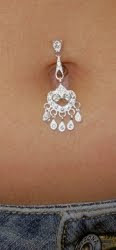
How to Properly fit a Belly Button Ring

How to Properly fit a Belly Button RingGetting a proper fit on a belly button ring has nothing to do with your body size, it has to do with the angle and depth of the actual piercing.

There are standards in the industry, but your Piercer may have to make adjustments for your navel type. Some Piercers may not work within the standards that are set in the industry, making it more difficult to find jewelry that will fit correctly.

The standards for a navel piercing are 14 gauge for the thickness of the barbell and 3/8" to 7/16" for the length barbell to be worn, once the piercing has healed.

Your piercer will use a longer curved barbell, or a ring for the initial piercing. This is to allow for swelling and to leave room for proper cleaning.

Once the piercing has healed enough to change the jewelry, normally 2 months, it is time to determine the correct size for your navel piercing.

Let's begin with the correct way to measure a curved barbell. With the top ball threaded all the way on, you are going to measure in a STRAIGHT line, not along the curve of the barbell. The two points will be:

#1- Where the top ball meets the barbell on the under side of the ball.(holding the barbell up and down, as if it's being worn).

#2- Where the bottom design, or ball, meets the barbell on the top side of the ball.

Measure in a Straight line from these two points. The two pionts will both be on the inside of the curve.

Metric Conversion: 5/16"=8mm, 3/8"=10mm, 7/16"=11mm, 1/2"=12mm, 9/16"=15mm.

Do not fit the curved barbell to have no barbell showing. You need to have some barbell displayed, as this allows air to the piercing and prevents the jewelry from trying to pull into the piercing. You should have about 1/4" of barbell showing.

You may need to experiment with a few sizes, to find your best fit. Here is the basic rule of thumb.

Shallow Piercings = 5/16" (8mm)

Standard Piercings = 3/8" (10mm) or 7/16" (11mm)

Deep Piercings = 1/2" (12mm)

Very deep Piercings = 9/16" (15mm)

Most shops only sell the standard length, because most manufactures only produce the one size. Our shop has a large selection of all lengths, because we manufacture many of our designs.

powered by Blogger | WordPress by Newwpthemes | Converted by BloggerTheme